
Last week, we asked whether organizations actually know what technology they have.
That sounds like a simple question.
But even if you built a perfect baseline today, there is another problem:
Tomorrow, something changes.
A technology baseline is not a finished document.
It is a point-in-time understanding of an environment that never stops moving.
Contracts renew.
Locations open and close.
Employees join and leave.
Applications are added.
AI tools appear.
Cybersecurity requirements change.
Vendors change their products.
Pricing changes.
Usage changes.
Businesses acquire other businesses.
Services get disconnected—or sometimes remain active long after they should have been disconnected.
The question isn't simply:
Do you know what you have?
It's:
How long does that answer remain true?
A BASELINE IS A STARTING POINT, NOT A FINISH LINE
An accurate technology inventory created in January can already be incomplete by March.
Not because anyone failed.
Because businesses change.
Technology changes.
Vendors change.
And the environment reflects all of it.
Consider what happens to a single service over time.
The business requirement changes.
Usage grows or shrinks.
The vendor changes pricing.
A contract approaches renewal.
A location moves.
Another technology begins depending on it.
A replacement becomes available.
The service that made perfect sense two years ago may still be exactly right.
Or the environment around it may have changed enough that the decision needs to be revisited.
The baseline doesn't become useless because one field changes.
It becomes less reliable when enough changes accumulate and nobody updates the picture.
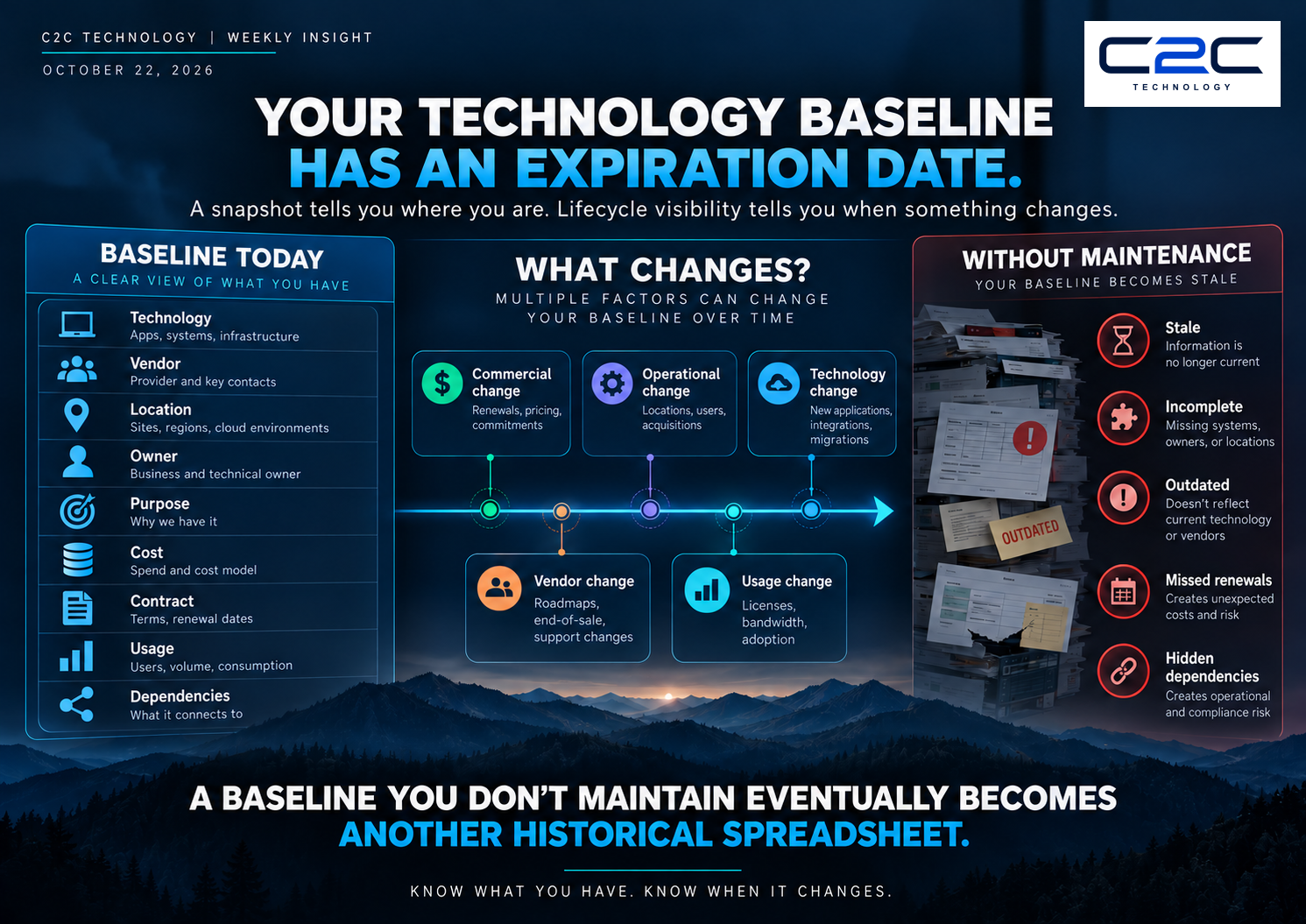
WHAT MAKES A BASELINE DECAY?
COMMERCIAL CHANGE
Contracts renew.
Pricing changes.
Minimum commitments change.
Promotions expire.
Notice periods approach.
Commercial terms that were attractive three years ago may no longer reflect today's market.
OPERATIONAL CHANGE
Locations open.
Locations close.
Employees move.
Departments reorganize.
Companies acquire other companies.
A technology that once supported one business requirement may now support something entirely different.
TECHNOLOGY CHANGE
New applications enter the environment.
Systems integrate.
Platforms migrate.
Infrastructure changes.
A new application can create a dependency on something that previously operated independently.
VENDOR CHANGE
Vendors change too.
Products are renamed.
Services reach end-of-sale.
Support models change.
Companies are acquired.
Roadmaps shift.
The recent Lumen portfolio changes were a useful reminder of this.
Knowing that an organization uses Lumen DIA is one piece of information.
Knowing which locations use it, which contracts govern it, which projects depend on it, and what future decisions could be affected when the vendor changes direction is something much more useful.
USAGE CHANGE
A company may purchase 500 licenses and eventually need 350.
Bandwidth requirements grow.
Cloud consumption changes.
An AI platform moves from experimentation into a critical workflow.
Another application quietly stops being used.
The technology may not have changed.
Its relationship to the business did.
WHEN THE BASELINE STOPS REFLECTING REALITY
This is how an organization's technology record slowly becomes historical.
Not through one dramatic event.
Through hundreds of small changes.
One contract renewal that wasn't updated.
One new SaaS application.
One closed location.
One additional carrier circuit.
One changed business owner.
One acquisition.
One integration.
One AI subscription.
One pricing change.
Eventually, the baseline describes the environment the organization used to have.
And that's dangerous because outdated information can look authoritative.
A spreadsheet can be beautifully organized and still be wrong.
A contract database can be complete and still fail to reflect operational reality.
An invoice can tell you exactly what you're paying without telling you whether you should still be paying it.
A baseline you don't maintain eventually becomes another historical spreadsheet.
THE PROBLEM SHOWS UP AT DECISION TIME
The consequences usually appear when the business needs to make a decision.
A renewal arrives.
Leadership asks where costs can be reduced.
A location closes.
A new location opens.
A security event occurs.
A vendor changes direction.
A company is acquired.
Someone proposes replacing a platform.
Suddenly everyone needs current information.
If the baseline has been maintained, the organization starts with facts.
If it hasn't, the organization starts reconstructing reality.
Again.
Invoices.
Contracts.
Portals.
Spreadsheets.
Emails.
Vendor calls.
Department meetings.
People's memories.
That's the difference between maintaining visibility and periodically rebuilding it.
LIFECYCLE VISIBILITY CHANGES THE CONVERSATION
A good baseline answers:
What do we have?
Lifecycle visibility adds:
What changed?
What is about to change?
What requires a decision?
That means recognizing:
Contracts approaching renewal.
Services associated with closed locations.
Licenses whose usage has changed.
Vendors changing their product strategy.
Technologies approaching replacement.
Costs changing materially.
Dependencies appearing or disappearing.
Business requirements evolving.
The goal isn't to constantly change technology.
Quite the opposite.
Sometimes the correct lifecycle decision is:
Do nothing.
The service still fits.
The pricing is reasonable.
The technology meets the requirement.
The contract makes sense.
Leave it alone.
But that's still a decision.
And good decisions require current information.
WHY THIS MATTERS NOW
Technology environments are changing faster than ever.
Cloud made infrastructure dynamic.
SaaS made applications easier to acquire.
Cybersecurity created increasingly specialized technology stacks.
AI is introducing entirely new tools and subscriptions across organizations.
Telecom providers continue changing products, architectures, and commercial models.
The environment isn't going to become more static.
That means the information used to manage it can't remain static either.
A once-a-year spreadsheet update isn't lifecycle management.
Neither is waiting until the vendor sends a renewal notice.
The earlier an organization sees a change, the more options it usually has.
QUESTIONS WORTH ASKING
- When something changes in our technology environment, who updates the baseline?
- Do contract renewal dates trigger action before the vendor controls the timeline?
- Are new applications, services, and subscriptions consistently added to our records?
- When a location closes, do we know every technology service tied to it?
- Can we see when usage materially changes from what we originally purchased?
- Do we know when a vendor's roadmap affects technology we currently depend on?
- How quickly does our current technology documentation become stale?
THE BOTTOM LINE
Knowing what you have is essential.
But knowing what you had six months ago isn't enough.
Technology changes.
Contracts change.
Vendors change.
Businesses change.
Requirements change.
The environment you understand today will not be the environment you have a year from now.
That's why a baseline cannot be treated as a finished document.
It has to remain connected to the lifecycle of the technology it describes.
A snapshot tells you where you are.
Lifecycle visibility tells you when something changes.
And that's what keeps the baseline useful.
How current is your technology baseline today?